
$3.00
 <—
1 in stock
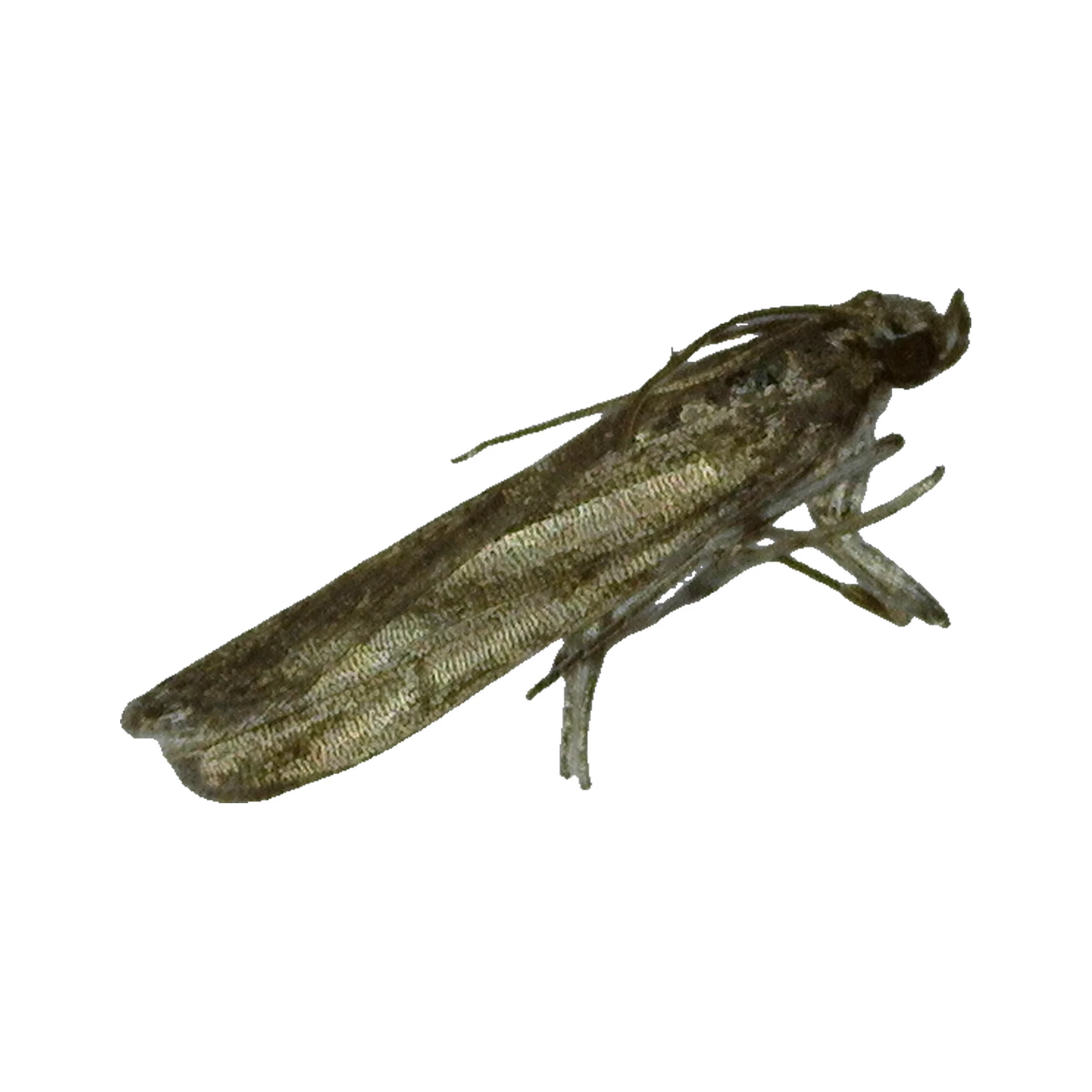
Twirler moths are small, narrow-winged micro-moths, and our specimen is about 10 mm long. The forewings are long and slim with a narrowly rounded or pointed tip, and at rest they lie flat over the back so the moth looks like a tiny brown cigar. Most twirler moths are drab brown, gray, or black, often with small dark spots or a mottled pattern. The best clue is the head: the long, three-segmented labial palps curve upward in front of the face like a pair of small horns, and the last segment is long and tapering. The antennae are threadlike. The hindwings are hidden at rest, but when spread they are usually trapezoidal, with the tip drawn out to a point and the edge below it notched or concave.
Twirler moths are one of the biggest micro-moth families, with about 886 species in North America and more than 4,600 worldwide. They live almost anywhere there are host plants, from woodlands and old fields to gardens, orchards, farm fields, and grain stores. Some of our specimens were collected near Saint James, Missouri.
Most adults are active at night and come to lights, though some rest on leaves or bark by day. The family gets its common name from the habit of spinning in circles on leaf surfaces. The caterpillars are concealed feeders. Depending on the species they mine inside leaves, roll or tie leaves with silk, form galls, or bore into stems, roots, fruit, and seeds.
Complete metamorphosis (egg, larva, pupa, adult). Many species pupate inside the leaf roll, silk tube, or shelter the caterpillar made, or in nearby leaf litter. Some species have one generation a year and others have several, and the host plants range from grasses and weeds to trees and shrubs.
Many twirler moths are harmless, but this family includes some serious crop and stored-food pests. Examples are the pink bollworm of cotton, the peach twig borer, the tomato pinworm, the potato tuber moth, and the Angoumois grain moth, whose caterpillars ruin stored grain. Other species help people: the spotted knapweed seedhead moth has been used to control spotted knapweed, an invasive weed.
Look at the palps first. Long, upcurved palps that reach up past the eyes, plus a narrow flat-lying wing shape, point to a twirler moth. In the similar-looking knot-horn moths (Phycitinae, a group of snout moths), the palps usually stick out straight forward like a snout. This is a family-level identification, so it is listed as Gelechiidae sp.
This preserved specimen educates on micro-moth diversity and twirler moth anatomy, suitable for displays or studies. Check it out on BugGuide! https://bugguide.net/node/view/7747