
$3.00
 <—
120 in stock
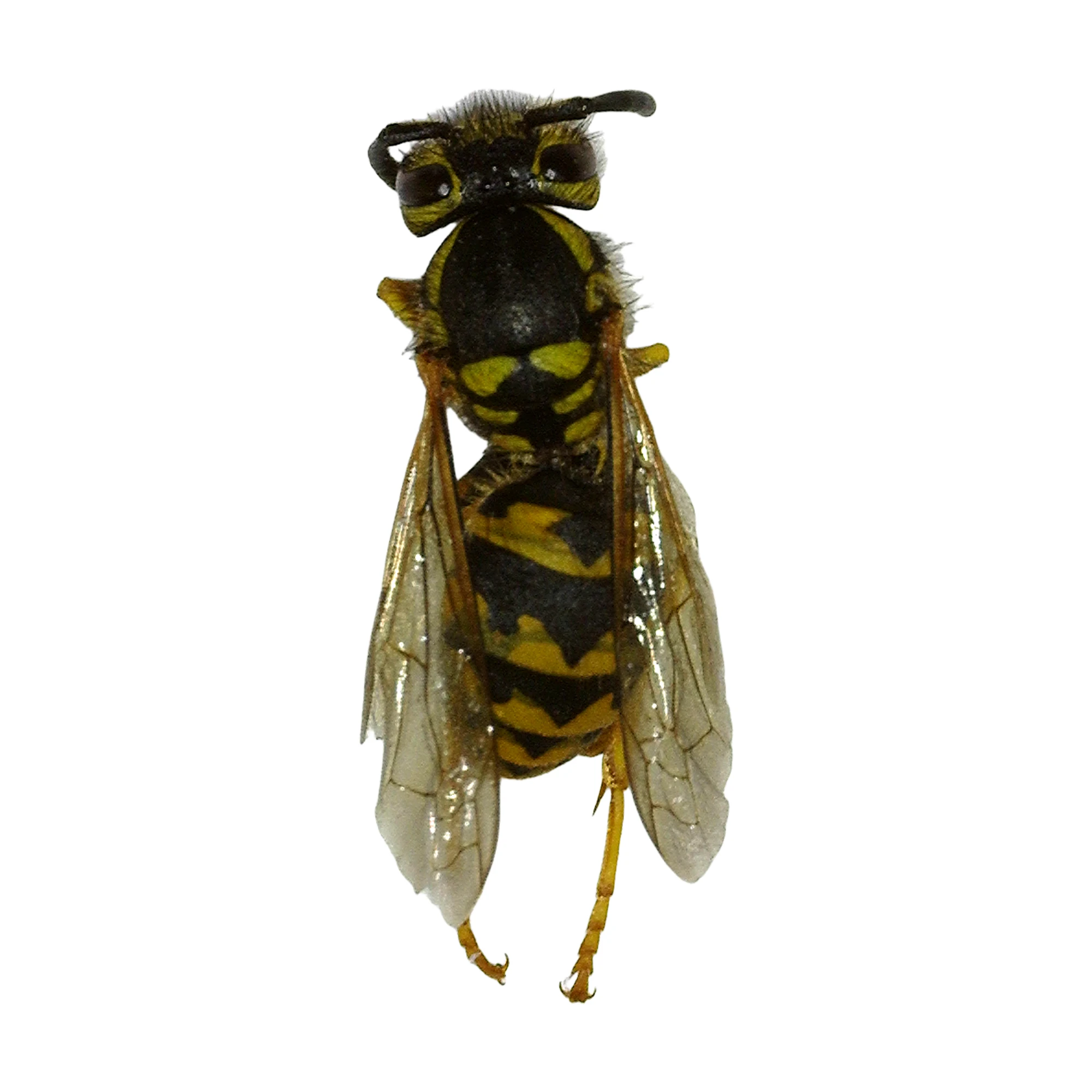
The Eastern Yellowjacket, Vespula maculifrons, is a black and yellow social wasp with a smooth, shiny body. Workers, the sterile females that make up most of a colony, are about 8.5 to 12 mm long, males are about 12 to 15 mm, and queens are the largest at up to about 18 mm. The best clue to the species is on the first segment of the abdomen, which carries a wide, flat-topped black mark shaped like an anchor with a short, narrow base. The anchor is more than twice as wide as it is long. Workers and males have no separate black spots on the abdomen, while queens have free black spots as well as the anchor. In the southern part of its range, individuals are often paler, with more yellow and less black.
The Eastern Yellowjacket lives in the eastern half of the United States and in southeastern Canada, from Nova Scotia west to Manitoba, and west to Montana, Wyoming, Colorado, and New Mexico, with a population reaching northeastern Mexico. It is one of the most abundant yellowjackets east of the Great Plains and lives in forests, meadows, woodland edges, and in cities and suburbs. Colonies are usually built underground, often in an old rodent burrow, but nests are also found at ground level in stumps and logs and sometimes inside wall voids and attics. Some of our specimens were collected near Hot Springs, South Dakota.
This is a social wasp that lives in a colony of hundreds or thousands of workers. The workers build the paper nest from chewed wood fibers, hunt, gather nectar and other sugary foods, feed the larvae, and defend the nest. Adults feed on nectar, while the larvae are fed chewed-up insects and other arthropods or scavenged meat. Workers also scavenge carrion, fruit, and human food and drinks. Like other yellowjackets, they defend the nest fiercely when it is disturbed, and they can sting repeatedly. The Eastern Yellowjacket is also the main host of the Southern Yellowjacket, Vespula squamosa, whose queens take over its nests.
The Eastern Yellowjacket undergoes complete metamorphosis (egg, larva, pupa, adult). A mated queen spends the winter alone in a sheltered spot and in late spring (May to June) starts a nest, building a small comb and a paper envelope around it and raising the first workers herself. The workers then take over the building and foraging while she lays eggs, and the colony grows through the summer. In late summer the nest produces new queens, and males, which hatch from unfertilized eggs, leave to mate. Most colonies die with the cold weather in November or December, and only the mated young queens survive the winter. In the warm south, a few colonies with several queens can last for more than one year.
The Eastern Yellowjacket is both beneficial and a pest. Its workers kill many caterpillars, flies, and other insects, which is a natural form of pest control. It is also one of the most common and most bothersome yellowjackets in the northeastern United States, because it scavenges around picnics, garbage cans, and outdoor events in late summer and fall, and nests close to homes can deliver many painful stings, which are dangerous to people who are allergic. Nests are best left alone in quiet places and removed by professionals only when they are near doors, yards, or busy areas.
This preserved specimen educates on social wasp colonies and ground-nesting yellowjackets, suitable for displays or studies. Check it out on BugGuide! https://www.bugguide.net/node/view/11564