
$3.00
 <—
2 in stock
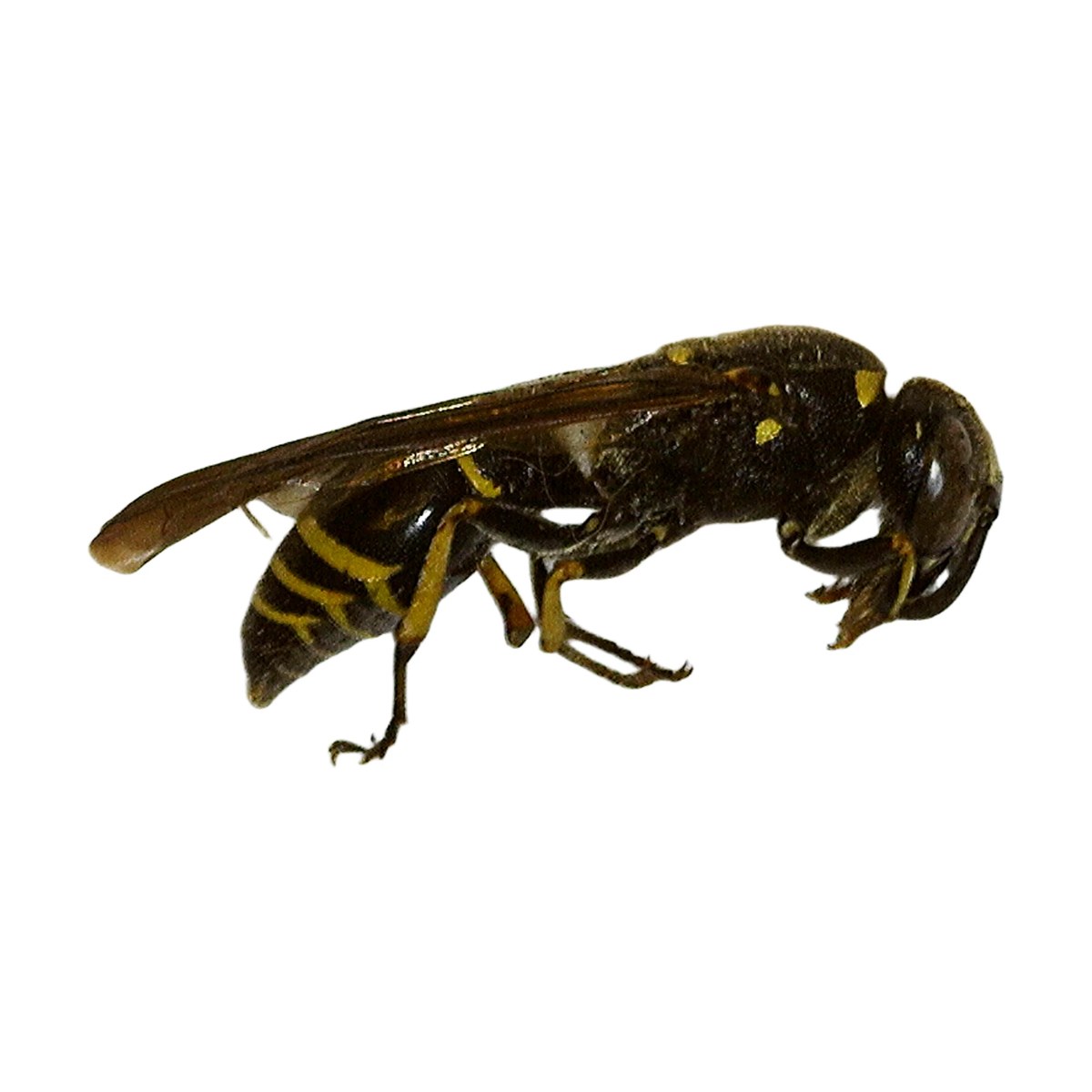
Mason wasps belong to the subfamily Eumeninae, a large group of solitary wasps in the family Vespidae, the same family as the yellowjackets and paper wasps. They are about 10 to 20 mm long and are usually black or brown with contrasting yellow, white, or orange markings. The specimens we offer are mostly black with thin yellow bands on the abdomen, small yellow spots on the face and the front of the thorax, and smoky brown wings. Like other vespid wasps, mason wasps fold their wings lengthwise when at rest, so the wings look like narrow strips lying along the body. The abdomen of our specimens is broad at the base, without the long, narrow stalk of the potter wasps of the genus Eumenes. More than 260 species in 25 genera live in North America, and many of them look alike, so this listing is offered at the subfamily level and the species you receive may vary.
Eumeninae are found worldwide, in habitats from northern forests to deserts, and they are active throughout the warm season. Adults visit flowers, and females look for nesting sites in old beetle borings in wood, hollow plant stems, rock crevices, and similar cavities, while some species dig nests in the ground. Some of our specimens were collected near Cloquet, Minnesota.
Mason wasps are solitary hunters. Each female builds and provisions her own nest and there is no colony or worker caste. She hunts caterpillars, mostly of moths, or in some species the larvae of leaf-feeding beetles, stings them to paralyze them, and packs them into a cell as food for her young. Adults feed on nectar. Females can sting but do not defend their nests and are rarely aggressive toward people.
Mason wasps undergo complete metamorphosis (egg, larva, pupa, adult). In many species the female lays a single egg in each cell, often hanging it from the ceiling on a short thread, and then fills the cell with paralyzed prey. She seals each cell with a partition of mud, and this use of mud gives the group its common name. When a nest is finished she closes it with a mud plug. The larva eats the stored prey, pupates inside the cell, and emerges as an adult, in some species after overwintering in the nest.
Mason wasps are beneficial. They remove large numbers of caterpillars, including some crop and garden pests, and the adults visit flowers for nectar. They rarely sting and are not considered pests, though their mud plugs can occasionally fill keyholes and small openings in buildings.
This preserved specimen educates on solitary wasps and their mud nests, suitable for displays or studies. Check it out on BugGuide! https://www.bugguide.net/node/view/249