
$3.00
 <—
1 in stock
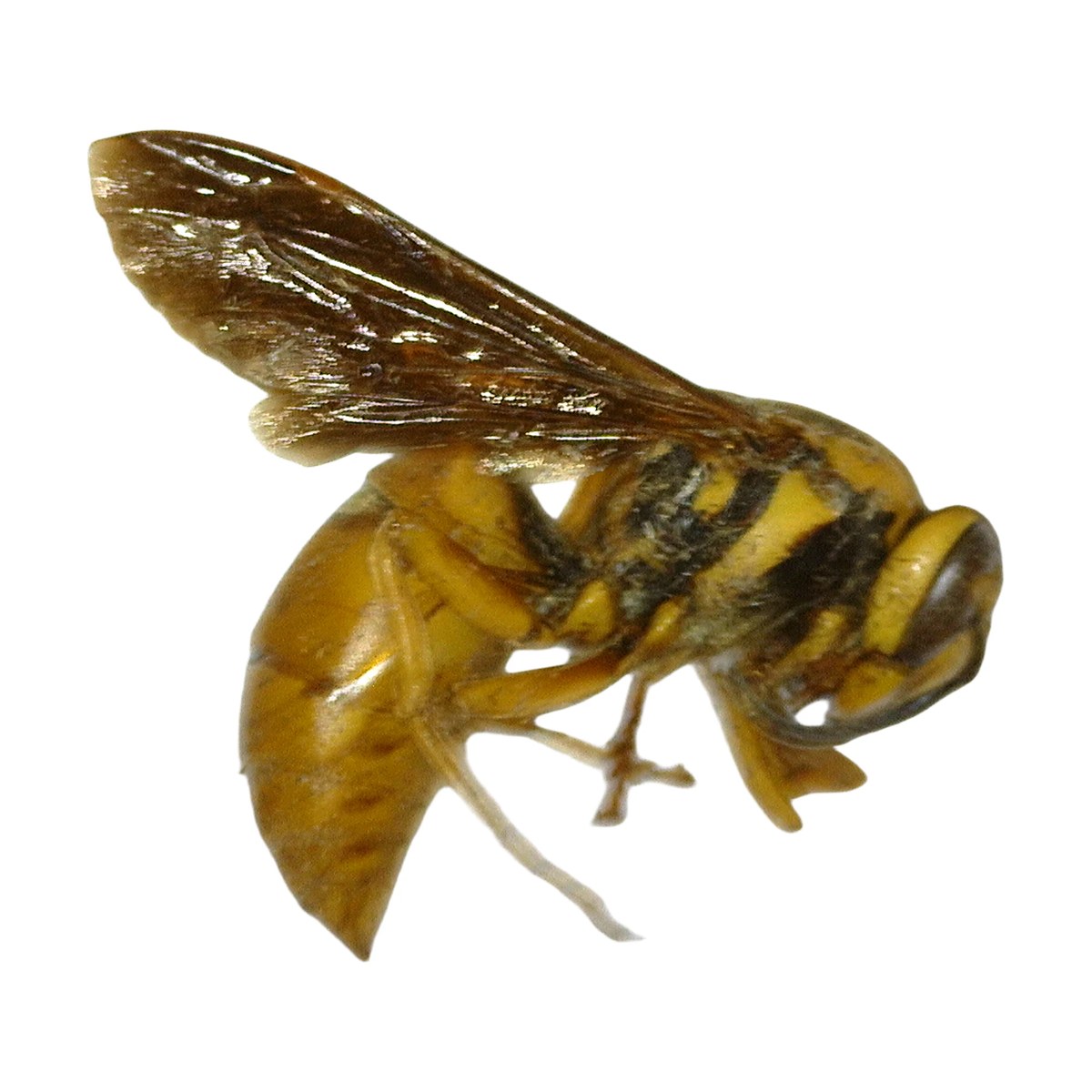
The Southern Yellowjacket, Vespula squamosa, is the most distinctive yellowjacket in the eastern United States. In every caste (queen, worker, and male), the top of the thorax carries a pair of long yellow stripes running front to back, a mark found on no other yellowjacket in its range. The queens and workers look very different. Workers and males have a black and yellow abdomen with a pair of yellow side stripes cutting into the black band on the second segment, and workers have forewings about 9.5 to 11 mm long. Queens are very large for a yellowjacket, with forewings about 15 to 16.5 mm long, and their yellow abdominal bands are tinged with orange and spread so far that almost all the black is lost, leaving a mostly orange-yellow abdomen with only faint dark spots. The specimen pictured is a queen.
The Southern Yellowjacket lives in the eastern United States, from New York to Florida and west to Wisconsin, Iowa, Nebraska, Kansas, Oklahoma, and Texas, and it also occurs in Mexico and Central America as far as Honduras. It thrives in disturbed places such as lawns, yards, and towns. The colonies are mostly built underground, but nests in hollow walls and other above-ground cavities are not uncommon around buildings. Some of our specimens were collected near Phelps County, Missouri.
Workers hunt live insects and other arthropods to feed the grubs and also scavenge on carrion. Like other yellowjackets, they defend the nest and can sting readily, and they are a frequent nuisance around people in the southeastern states because the species likes disturbed ground close to homes. The queen has an unusual habit: she is a facultative social parasite. She emerges in spring about a month after her main host, the Eastern Yellowjacket (Vespula maculifrons), when many young host nests are just getting started. She invades one, kills the host queen, and takes over the nest, and the host workers raise her young. In studies in Georgia, about 80 percent of Southern Yellowjacket colonies started this way, although she is still able to found a nest on her own.
The Southern Yellowjacket undergoes complete metamorphosis (egg, larva, pupa, adult). A queen either founds a nest alone or takes over a young nest of another yellowjacket. If she usurps a nest, the original host workers die off over time and the colony becomes entirely Southern Yellowjackets. The colony grows through summer and usually declines in November, earlier than the Eastern Yellowjacket. New queens and males are produced, and mated young queens overwinter. In the far southern part of its range, colonies sometimes survive more than one year and hold several queens.
The Southern Yellowjacket is both beneficial and a nuisance. The workers kill many caterpillars, flies, and other insects. But because it nests near homes and scavenges for meat and sweets, it often pesters people at picnics and garbage cans, and a disturbed nest can deliver many painful stings, which are dangerous to people who are allergic. Nests should be left alone in quiet places and handled by a professional if they are close to doors or busy areas.
This preserved specimen educates on yellowjacket castes and social parasitism, suitable for displays or studies. Check it out on BugGuide! https://bugguide.net/node/view/7097