
$3.00
 <—
3 in stock
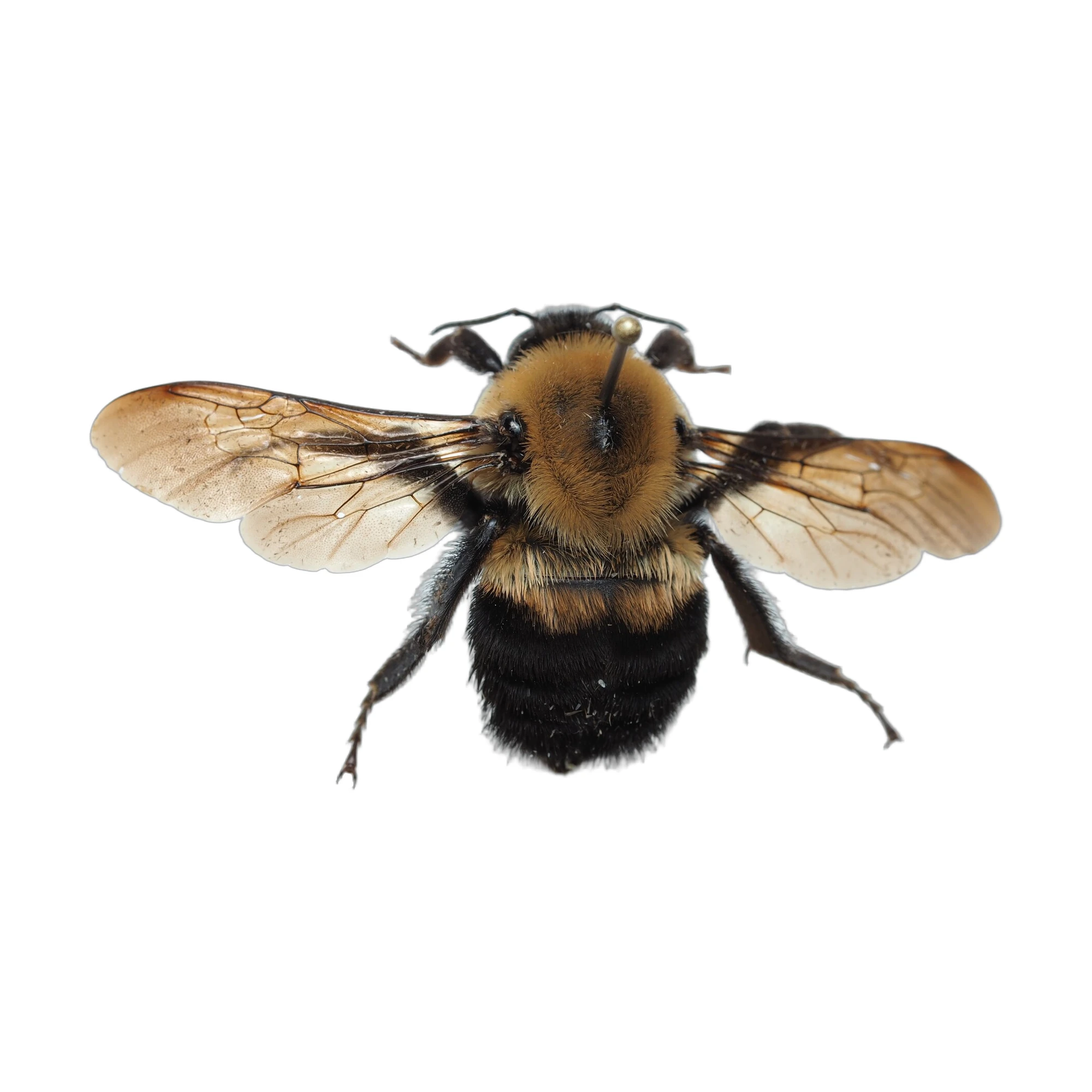
Bumble bees in the genus Bombus are large, robust, very hairy bees, roughly 10 to 25 mm long depending on species and caste, with queens the largest and workers the smallest. Most North American species are banded in black and yellow, and some add orange, red or white hair. Females carry a smooth, shiny pollen basket (corbicula) on each hind leg. The exact color pattern is the main clue to species, so unidentified specimens can vary.
Nearly 50 species occur in North America, from the Arctic and high mountains south through Mexico. They are most diverse in cool temperate and mountain regions and live in meadows, prairies, forest edges, farmland, gardens and tundra.
Most bumble bees live in annual social colonies of a queen and her workers, nesting underground in old rodent burrows or on the surface in thick grass. They forage on a wide range of flowers and can buzz-pollinate, shaking pollen loose by vibrating their flight muscles. Their size and hair let them fly in cool weather when many other bees stay inactive. Cuckoo bumble bees (subgenus Psithyrus) make no workers and take over the nests of other species instead.
A mated queen leaves hibernation in spring, finds a nest site and stocks wax cells with pollen and nectar before laying eggs. The young go through complete metamorphosis (egg, larva, pupa, adult). Workers take over foraging through summer, new queens and males are produced in late summer, and only the mated queens survive the winter.
Bumble bees are important native pollinators of wildflowers and crops such as tomatoes, blueberries, cranberries, clover and peppers, and some species are raised commercially for greenhouse pollination. Several North American species have declined due to habitat loss, pesticides and disease, making the genus a focus of pollinator conservation.
This preserved specimen educates on native bumble bees and their role as pollinators, suitable for displays or studies. Check it out on BugGuide! https://bugguide.net/node/view/3077
Only logged in customers who have purchased this product may leave a review.
Reviews
There are no reviews yet.