
$3.00
 <—
9 in stock
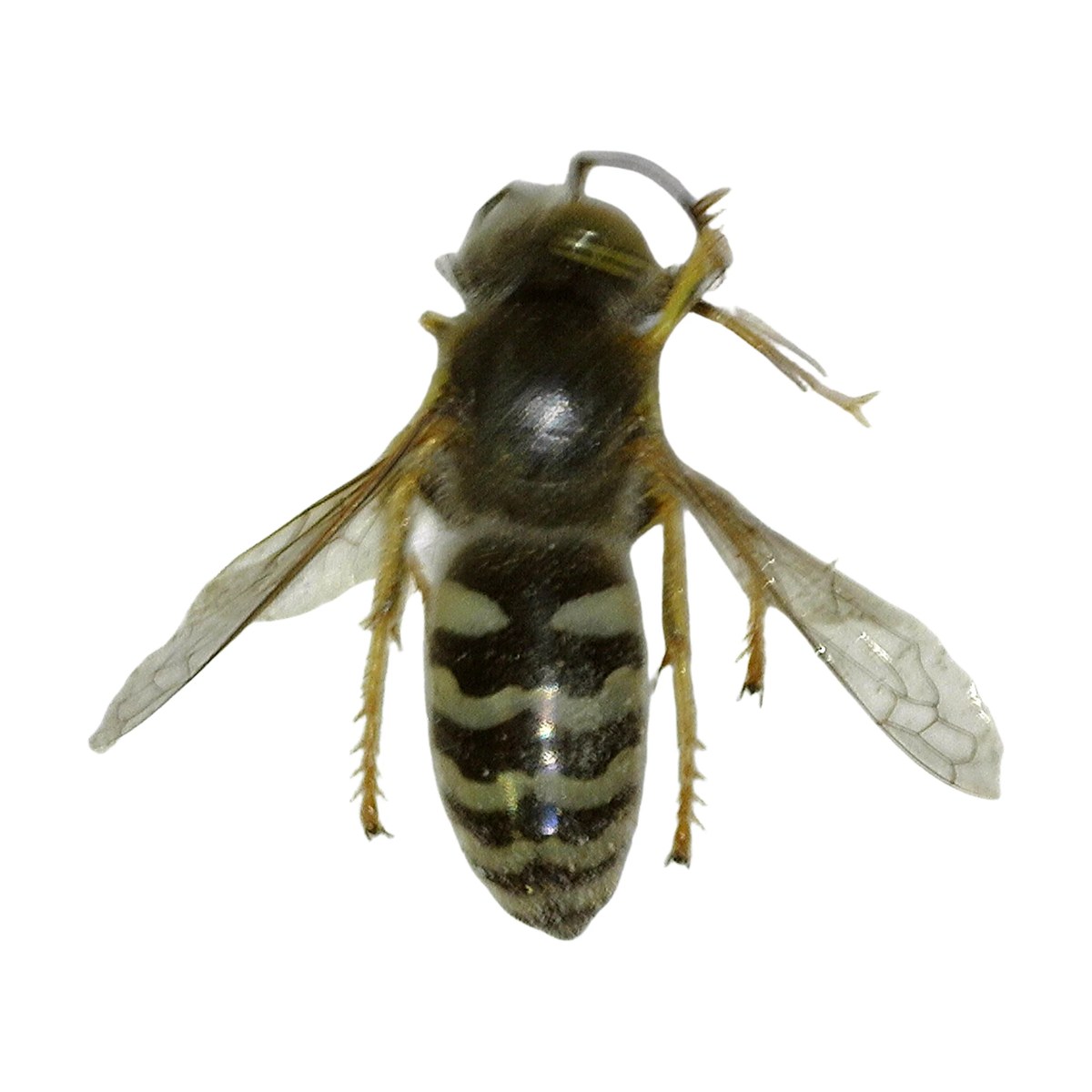
The Aerial Yellowjacket, Dolichovespula arenaria, is a medium-sized, black and yellow social wasp. Workers have forewings about 9 to 12 mm long and are roughly 12 to 17 mm in total length, with queens a little larger. The abdomen is black with pale yellow bands that have a wavy or notched edge, and the first two bands are interrupted or notched in the middle. The legs are largely yellow, and the face and a wide stripe behind each eye are yellow. Dried specimens often fade to a creamy yellow. A good way to separate Dolichovespula from the ground yellowjackets of the genus Vespula is the malar space, the gap between the bottom of the eye and the base of the jaw: it is long in Dolichovespula, about twice the width of a simple eye, while in Vespula the eye nearly touches the jaw. The only other yellow-marked Dolichovespula in the east, D. norvegicoides, has bands that are not notched in the middle and a black spot on the clypeus.
This is one of the most common wasps in North America. It is abundant across the northern part of the continent, from Alaska south through the northern and western United States to the mountains of New Mexico and Arizona, and east through the Great Lakes region to the Atlantic states. It is found in habitats from wooded areas to towns. Its paper nests are usually aerial, hung from grass and shrub stems, tree branches, and the walls and eaves of houses, sheds, and garages, though colonies are occasionally found under rocks or in the ground. Some of our specimens were collected near Douglas County, Wisconsin.
The Aerial Yellowjacket is a social wasp, and its workers build the paper nest from chewed wood fibers, hunt, feed the grubs, and defend the colony. Workers mostly hunt live prey such as grasshoppers, crickets, caterpillars, flies, lacewings, and spiders, and they only rarely visit carrion. Small colonies are usually not very aggressive, but a large nest that is disturbed can react strongly and sting repeatedly.
The Aerial Yellowjacket undergoes complete metamorphosis (egg, larva, pupa, adult), and each colony lasts one season. A mated queen spends the winter alone, then in spring she starts a new nest by herself and raises the first workers. The workers take over the building and foraging, and a colony may grow to a few hundred workers by midsummer. In late summer new queens and males are produced and leave to mate. The colony declines in late summer, the old queen, workers, and males die, and only the mated young queens survive the winter. The nest is not used again.
The Aerial Yellowjacket is mostly beneficial, since its workers kill large numbers of caterpillars, flies, grasshoppers, and other insects. It can also be a nuisance pest when it builds a nest on or near a house, shed, or doorway, because a disturbed colony can sting many times, which is dangerous to people who are allergic. Nests in quiet places are best left alone, and nests near doors or busy areas can be removed.
This preserved specimen educates on social wasp colonies and aerial paper nests, suitable for displays or studies. Check it out on BugGuide! https://bugguide.net/node/view/12983
Only logged in customers who have purchased this product may leave a review.
Reviews
There are no reviews yet.