Fleas can jump 350 times their body length! That’s equivalent to a human vaulting the Great Wall of China!

Fleas can jump 350 times their body length! That’s equivalent to a human vaulting the Great Wall of China!
$5.95
 <—
<—30 in stock
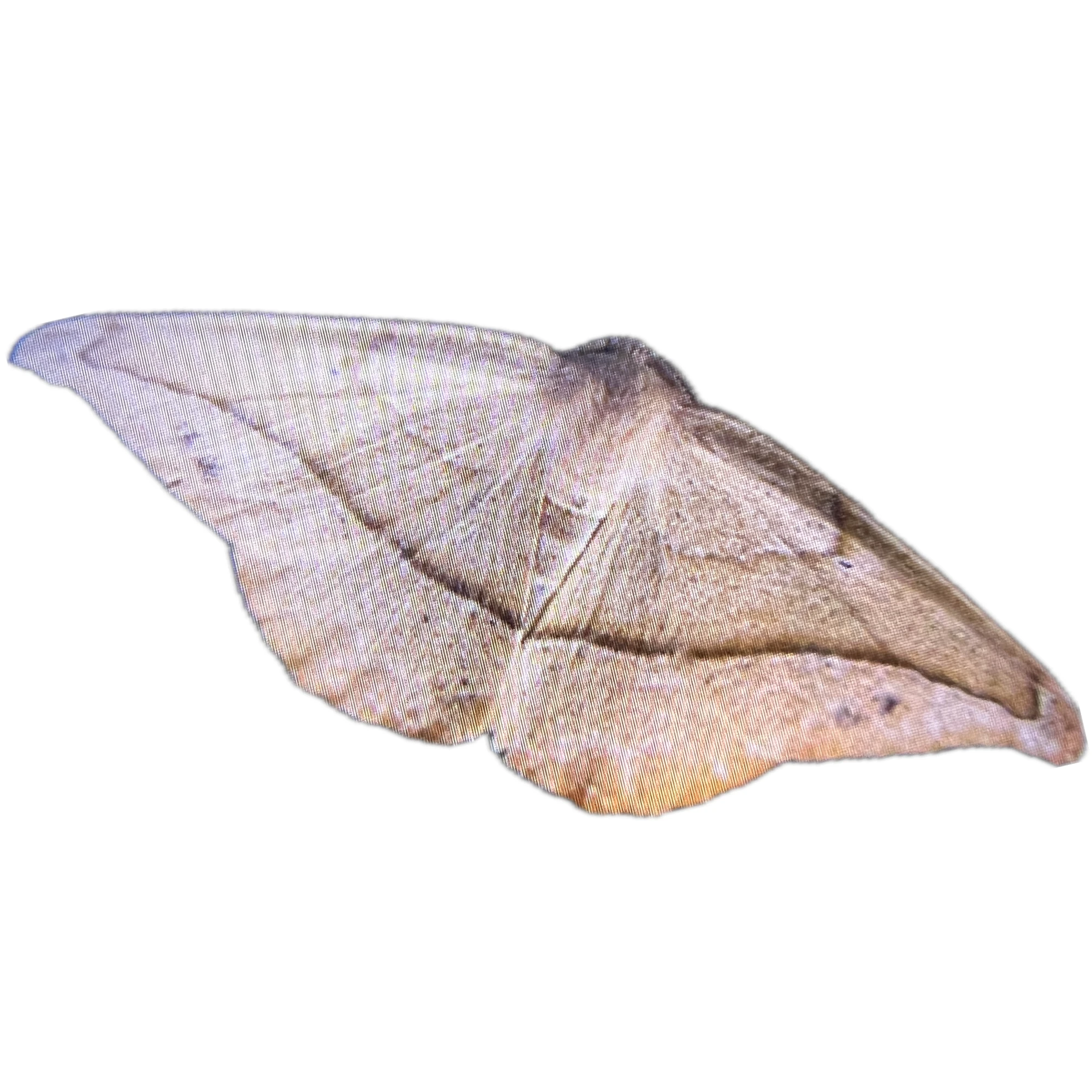
The Juniper-twig Geometer (Patalene olyzonaria) is a 21-25 mm geometrid moth with orangish to reddish-brown wings featuring a hooked forewing tip and sharp postmedial line. Larvae mimic twigs on juniper. Found in eastern North American woodlands from April to November. https://bugguide.net/node/view/8338
The Juniper-twig Geometer, Patalene olyzonaria, is a small geometrid moth with a wingspan of 21 to 25 mm. Adults vary from orangish, pinkish, or reddish-brown overall, with females showing a more pronounced hooked tip on the forewing than males. A sharp postmedial line curves back near the costa, while the discal dot sits closer to the antemedial line, sometimes nearly touching it. Some individuals display two large dark spots or a blotch in the lower subterminal forewing area, extending to both wings. The hindwing has a smoothly rounded outer margin and straight postmedial line. Larvae reach 30 mm, appearing brownish or grayish with dark angular dorsal and lateral lines forming diamonds, whitish subdorsal patches, and black dorsal warts on the ninth abdominal segment. The head shows a brown-gray base with dark herringbone patterns on lobes, enhancing twig mimicry.
This species inhabits successional pine and juniper woodlands, forest edges, and areas with host plants like Juniperus species. Its range spans from Quebec and New Hampshire south to Florida, west to Texas, and north to Wisconsin, favoring temperate eastern North American environments.
Adults are active from April to November, with peak flights aligning with warmer months. Larvae, present June to October in New England, feed on juniper foliage, occasionally Northern White Cedar or pine, blending seamlessly as twig mimics to avoid predators. As geometrids, they exhibit looper movement in larval stages, contributing to defoliation in host stands.
The multivoltine cycle produces two to three generations yearly, with eggs likely overwintering. Larvae hatch to feed and grow through instars, mimicking twigs for protection. They pupate in soil or debris before adults emerge for mating and oviposition. This rhythm supports broad seasonal activity.
This preserved specimen reveals geometrid camouflage artistry, ideal for lepidopteran collections or education. Check it out on BugGuide! https://bugguide.net/node/view/8338