
$3.00
 <—
22 in stock
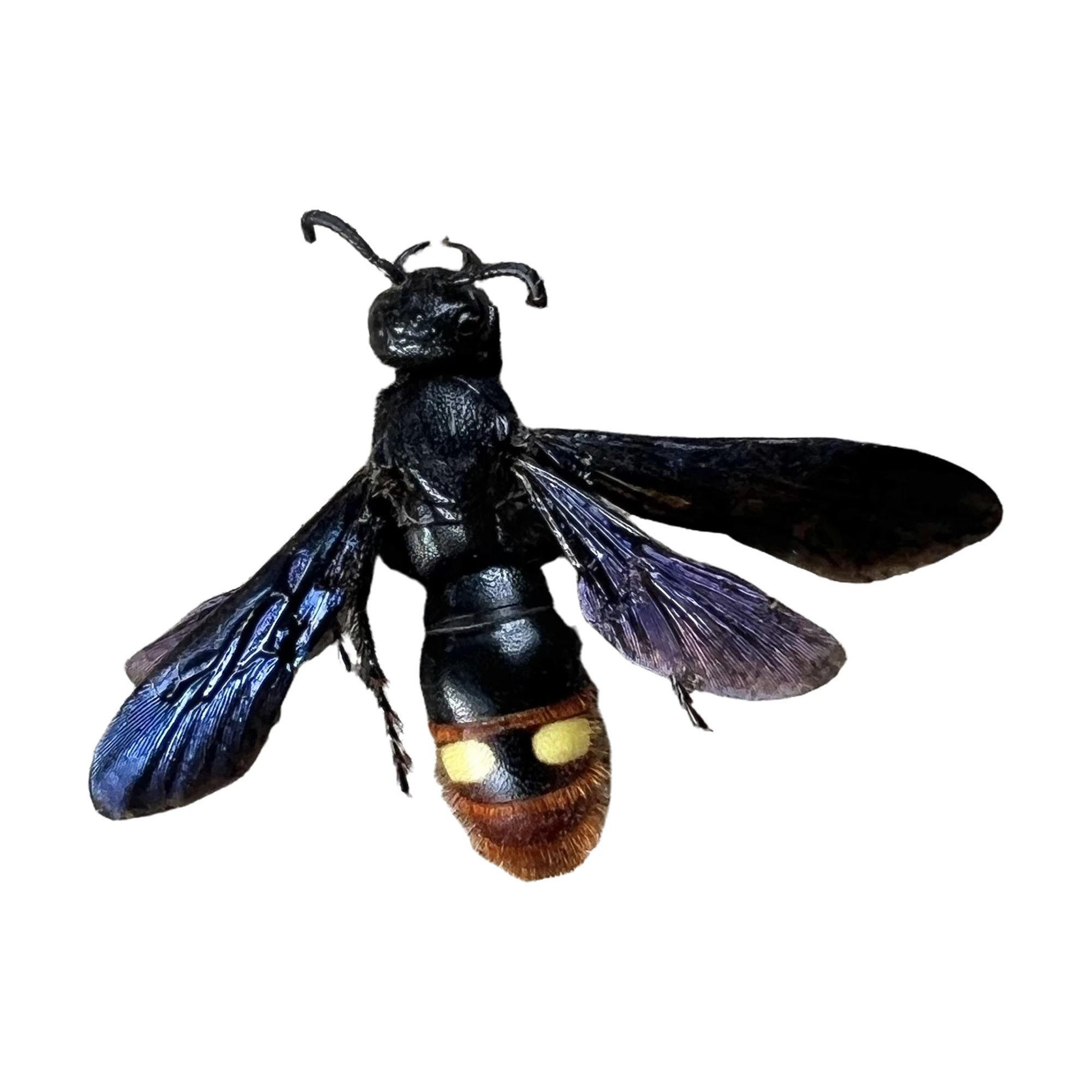
The Blue-winged Wasp, Scolia dubia, is a large, robust scoliid wasp measuring about 20 to 25 mm long. The head, thorax, and front half of the abdomen are shiny black, and the dark wings shine blue to purple in sunlight. The rear half of the abdomen is reddish orange and densely hairy, with two large yellow spots, one on each side, on the third abdominal segment. In flight these spots can look like a yellow band. The subspecies Scolia dubia haematodes lacks the yellow spots. Males have longer antennae than females and carry a three-pronged “pseudostinger” at the tip of the abdomen that is part of the mating equipment and cannot sting.
This native wasp occurs across much of the United States except the Northwest, from the St. Lawrence River south to Florida and west to Arizona. It is common in open, sunny places such as lawns, pastures, meadows, fields, and gardens, especially where the soil holds beetle grubs. Adults are often found visiting late summer flowers, especially goldenrod.
Adults fly from about June to October and are most abundant in August. They are often seen in groups flying just a few inches above a lawn in a loose figure-eight or S-shaped pattern. Males patrol for females this way, the two sexes perform a low courtship flight together, and females use the same flight to search for grubs in the soil below. Adults feed on nectar and pollen and may also drink juices from their beetle prey. At night they rest by burrowing into the soil. Blue-winged Wasps are not aggressive toward people and rarely sting unless stepped on or handled roughly.
Scolia dubia undergoes complete metamorphosis (egg, larva, pupa, adult). The female digs into the soil, often following a grub’s own tunnel, until she finds a scarab beetle grub, mainly the green June beetle (Cotinis nitida) and also the introduced Japanese beetle (Popillia japonica). She stings the grub, which paralyzes it permanently, sometimes drags it deeper and builds a cell around it, and then lays a single egg on it. The hatching larva is a pale, legless grub with a brown head that feeds on the paralyzed host and consumes it in about two weeks. It then spins a cocoon and spends the winter in the soil, pupates, and emerges as an adult the following summer. There is one generation per year in the North and more than one in the South.
The Blue-winged Wasp is beneficial. Its larvae are natural biological control agents of green June beetle and Japanese beetle grubs, which feed on the roots of turf and other plants, loosen the sod, and push up mounds of soil. Adults also help pollinate goldenrod and other late summer wildflowers. Because the wasps rarely sting and help control grubs, extension entomologists do not recommend controlling them; seeing them hovering over a lawn simply means grubs are present in the soil.
This preserved specimen educates on parasitoid wasps and natural biological control of lawn grubs, suitable for displays or studies. Check it out on BugGuide! https://bugguide.net/node/view/431
| Weight | 0.001 lbs |
|---|
Only logged in customers who have purchased this product may leave a review.
Reviews
There are no reviews yet.