
$5.95
 <–
1 in stock
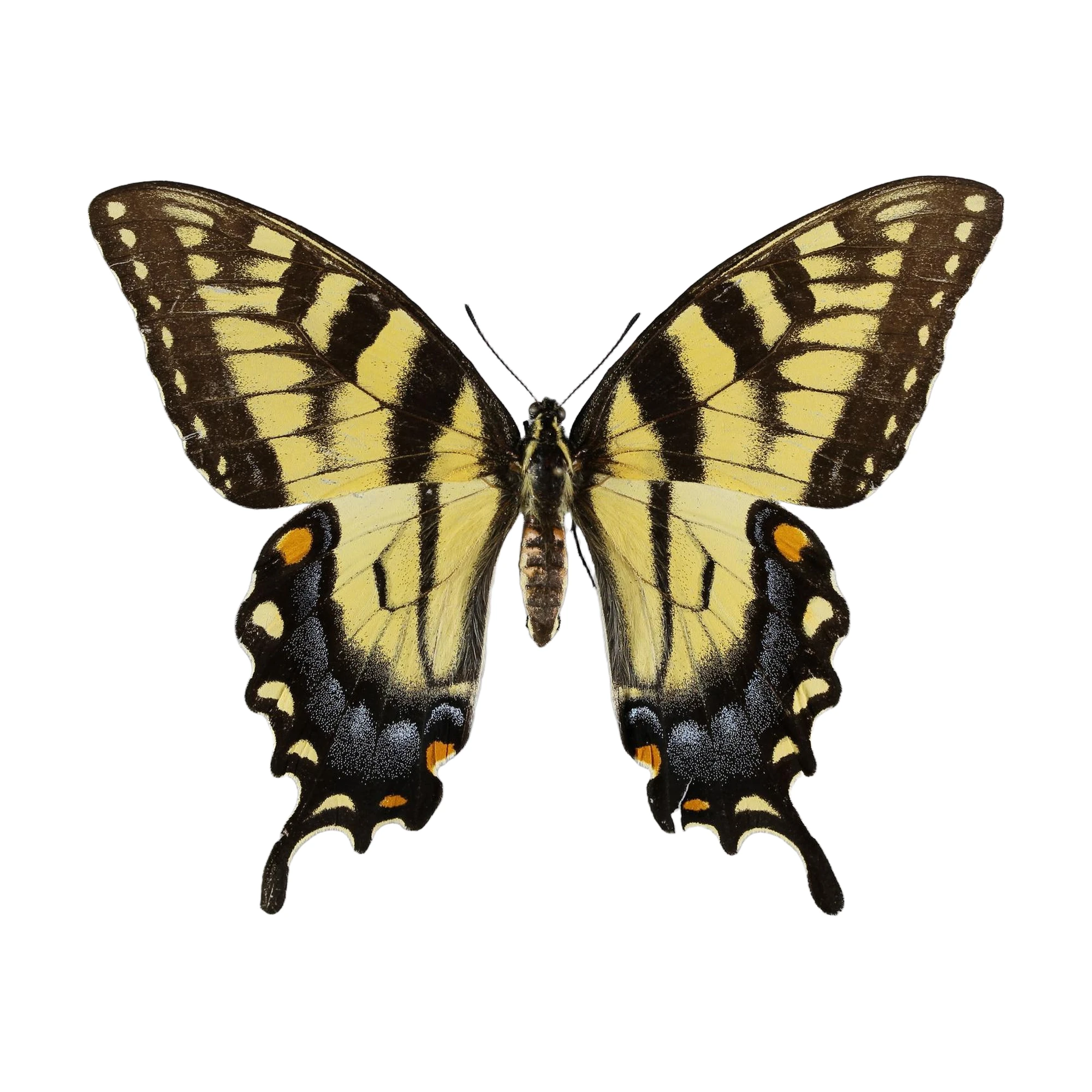
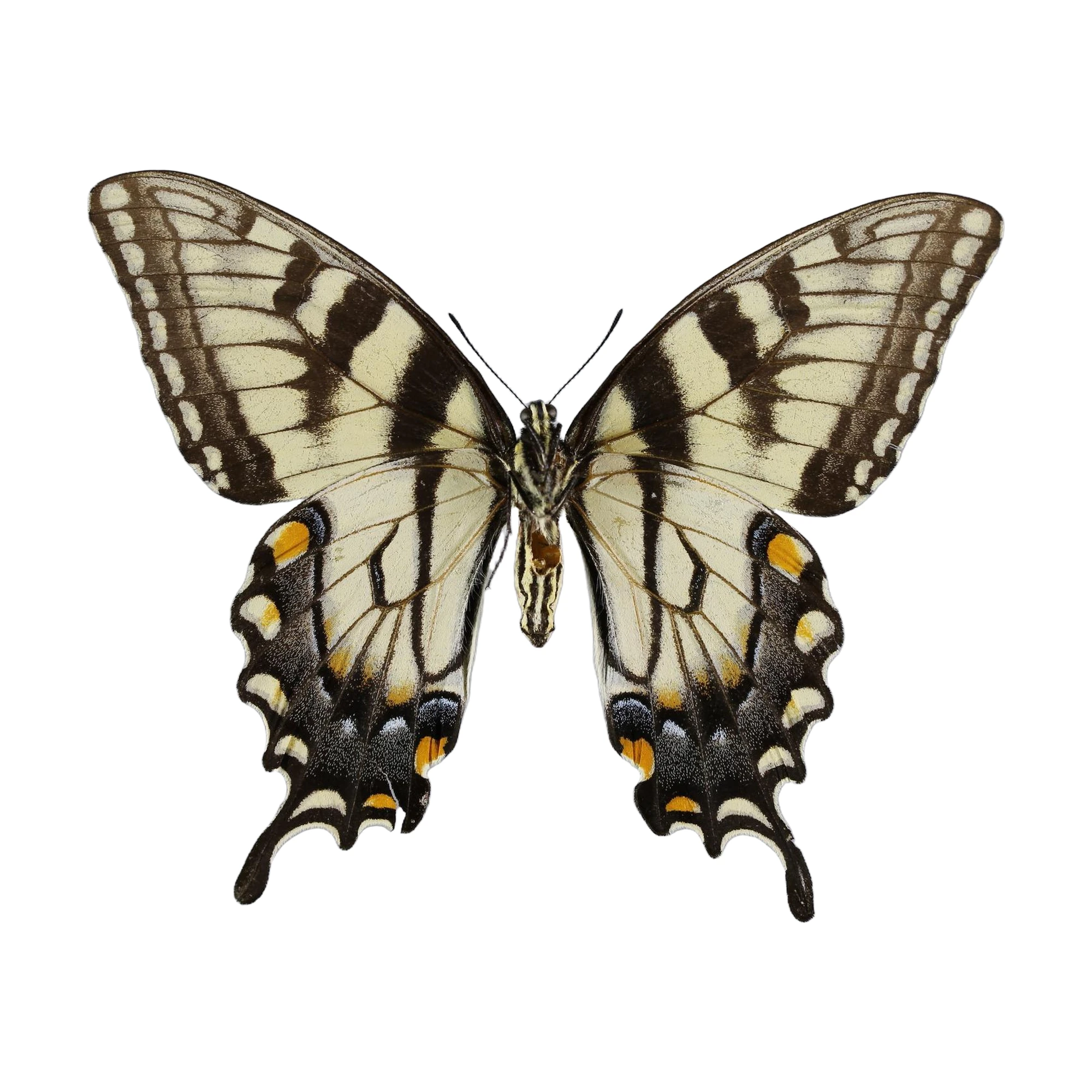
The Eastern Tiger Swallowtail, Papilio glaucus, is one of the largest and best known butterflies of eastern North America, with a wingspan of about 62 to 114 mm (2 1/2 to 4 1/2 inches). This listing is the yellow form, which is the color of all males and many females. The dorsal side is bright yellow with bold black tiger stripes, a black border dotted with yellow spots, and an orange spot and blue scaling near the base of each hindwing tail, stronger in females. The ventral side is paler yellow with the same black stripes and a row of orange spots on the hindwing. Our photos show spread museum specimens of the same species and form, dorsal and ventral.
The Eastern Tiger Swallowtail lives in deciduous woods, forest edges, river valleys, parks, and suburbs. Its range covers eastern North America, from Ontario south to the Gulf coast and west to the Colorado plains and central Texas. It is often seen where its host trees grow, along roads and streams, and in gardens.
Adults fly in two broods a year in the north, from May to September, and in three broods in the south, from February to November. Males patrol along woodland edges and streams looking for females, and groups of males often gather on damp mud and sand to take up minerals. Adults visit many flowers for nectar, including milkweed, Joe-Pye weed, thistle, and lilac.
Complete metamorphosis (egg, larva, pupa, adult). Females lay single eggs on the leaves of host trees such as wild cherry, tulip tree, sweetbay, basswood, ash, birch, cottonwood, and willow. Young caterpillars look like bird droppings, and older ones are green with two large eyespots. The chrysalis overwinters.
Not a pest. The caterpillars feed on the leaves of wild forest trees and cause little harm to the trees, and the adults help pollinate wild flowers.
Our specimen was collected in Douglas County, Wisconsin.
Please note that our specimen is damaged, with wing wear or chips and possibly a missing or bent antenna, which is why it costs less. The photos show undamaged examples.
This preserved specimen shows the bold yellow and black tiger stripes of this well known swallowtail, ideal for butterfly education and displays. Check it out on BugGuide! https://bugguide.net/node/view/491/bgimage
Photos: Yale Peabody Museum (YPM ENT 719579), photo by Lawrence F. Gall, CC0, via GBIF. Cropped, background removed. Photos are representative examples, not the exact insect you will receive.
| Weight | 0.01 lbs |
|---|
Only logged in customers who have purchased this product may leave a review.
Reviews
There are no reviews yet.