
$3.00
 <—
19 in stock
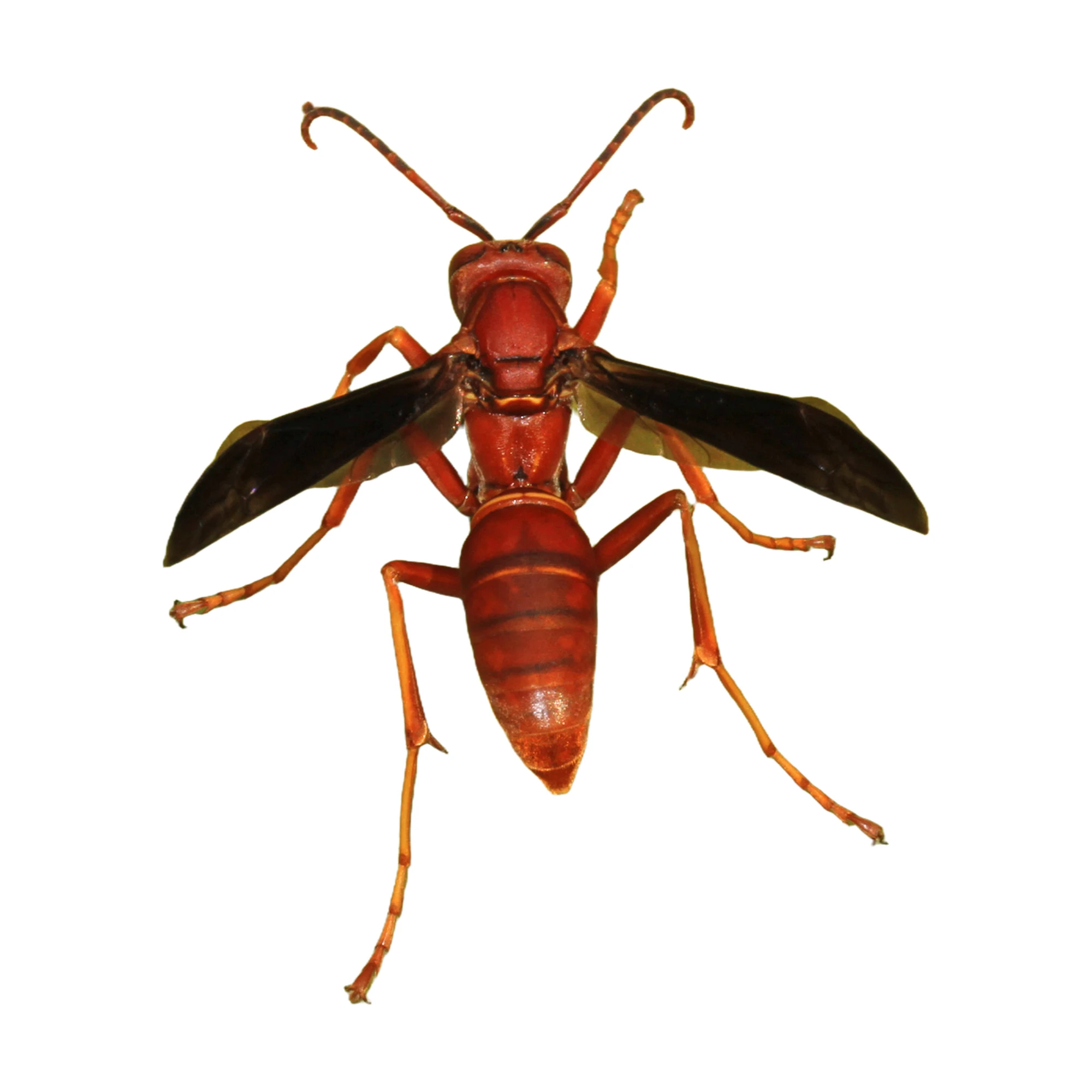
The Red Wasp, Polistes carolina, is a slender, long-legged paper wasp that is rusty red almost from head to tail. Females are nearly all red, with the body, legs, and antennae in shades of rust and orange, and the wings are smoky black to dark brown. Some individuals show a little yellow, such as a ring on the first abdominal segment, and males tend to have more defined dark marks on the legs and underside than females. The forewing is about 15 to 20 mm long, and the whole wasp is about 20 to 25 mm. It looks very much like the Coarse-backed Red Paper Wasp, Polistes rubiginosus, and the two are best told apart under magnification. In P. carolina the cheek is mostly bare and the ridges on the back of the thorax are fine or missing, while P. rubiginosus has silvery hairs on the cheek and coarser ridges. Compared with the darker Metric Paper Wasp, Polistes metricus, the Red Wasp has far less black on the thorax and abdomen.
The Red Wasp lives in the eastern United States, from New York and Pennsylvania south to Florida and west to Illinois, Kansas, and eastern Texas, and it has also been introduced to Bermuda. It is found in woodlands and the open areas near them, and it often nests around people, under the eaves and roofs of buildings and in sheltered spots such as old tires. Adults are most often seen in summer and fall. Some of our specimens were collected near Ringgold, Georgia.
This is a social wasp that lives in a colony led by a queen. The workers chew wood fibers into paper to build a single open comb of hexagonal cells that hangs from a short stalk, and the nest is usually no wider than about 15 cm (6 inches). Workers hunt mostly caterpillars and leaf beetle larvae, chew them into a ball, and feed them to the young, and they also drink nectar and visit flowers. They defend the nest and can deliver a painful sting if it is disturbed, so they are usually left alone when they are away from the nest.
The Red Wasp undergoes complete metamorphosis (egg, larva, pupa, adult). A mated queen spends the winter in a sheltered place, and in spring she starts a small nest by herself and lays an egg in each cell. The larvae grow in open cells and are fed by the adults, and when they are ready to pupate the workers cap each cell with a thin layer of paper. The first workers take over building and feeding while the queen lays eggs, and the colony grows through the summer to a few dozen wasps at most. In late summer and fall the colony produces new queens and males, which mate, and the males die soon afterward. The old queen and the workers die as the colony declines, and only the mated young queens survive the winter. The nest is not reused.
The Red Wasp is mostly beneficial, because its workers kill many caterpillars and other insects in gardens and crops, and the adults visit flowers for nectar. It becomes a nuisance when it nests close to doors, windows, and porches, where its stings can be painful and dangerous to people who are allergic. Nests in quiet places are best left alone, and those near people are best removed early in the season while the colony is small.
This preserved specimen educates on social wasps and how the red paper wasps of the eastern United States are told apart, suitable for displays or studies. Check it out on BugGuide! https://bugguide.net/node/view/581
| Weight | 0.01 lbs |
|---|
Only logged in customers who have purchased this product may leave a review.
Reviews
There are no reviews yet.