
$3.00

22 in stock
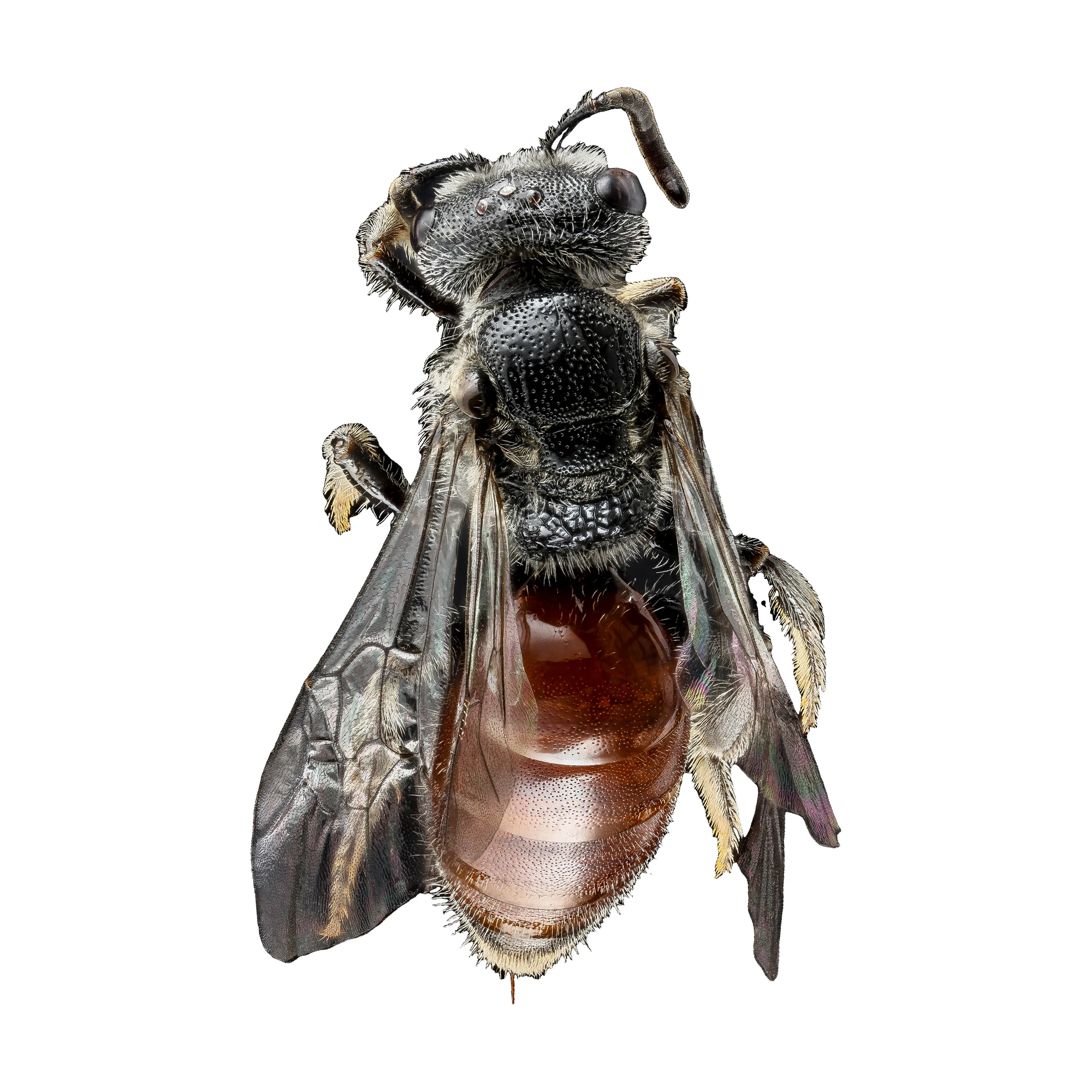
Sphecodes Bees, also called Blood Bees, are small to medium-sized bees, about 4 to 15 mm long depending on the species. Females of most species have a black head and thorax and a bright red abdomen, the source of that name, while males and a few species are mostly or entirely black. Unlike most bees they look almost hairless and shiny, and their body is covered with deep, coarse pits and ridges. This thick, armored skin helps protect them from the stings and bites of the bees whose nests they invade. Females have no pollen-carrying hairs on their legs, and like all sweat bees (family Halictidae) the main vein near the base of the front wing is strongly curved. These are real, US-collected specimens from Hot Springs in Fall River County, South Dakota.
The genus Sphecodes is found on every continent except Antarctica, with about 70 species in the United States and Canada. Sphecodes Bees live wherever their host bees nest, usually in sunny, open places with bare or sparsely vegetated soil, such as prairies, fields, roadsides, sandy banks, woodland openings and gardens. In South Dakota they have been recorded across the state, including the Black Hills and the prairies around them.
Sphecodes Bees are cuckoo bees. They do not dig nests or gather pollen. Instead, a female searches bare ground for the nests of other ground-nesting bees, mainly sweat bees in the genera Lasioglossum and Halictus, and sometimes mining bees, cellophane bees and others. She slips into the nest, opens a cell that the host has stocked with pollen and nectar, kills the host’s egg or young larva with her jaws, lays her own egg and seals the cell again. Spines on her strong hind legs help her brace inside the tunnel if the host fights back. Adults visit flowers only to drink nectar and are often seen on small flowers such as those of the carrot and aster families.
Like all bees, Sphecodes Bees go through complete metamorphosis (egg, larva, pupa, adult). The larva eats the food ball the host bee prepared for its own young, then pupates in the stolen cell. In many species the new adults appear in late summer and mate. The males die in fall, while the mated females spend the winter in the ground and come out in spring to hunt for host nests, just as their hosts begin provisioning. That is why females are often collected in spring, as these May specimens were.
Sphecodes Bees have little direct economic importance. They do not damage property and rarely sting. Although they parasitize native bees, they are a natural part of healthy bee communities, and finding them is a sign that their host bees are thriving. As they move between flowers for nectar they also do a small amount of pollination.
This preserved specimen educates on the fascinating cuckoo bees that live by invading the nests of other bees, suitable for displays or studies. Check it out on BugGuide! https://bugguide.net/node/view/16860
| Weight | 0.01 lbs |
|---|
Only logged in customers who have purchased this product may leave a review.
Reviews
There are no reviews yet.