
$3.00
 <---
62 in stock
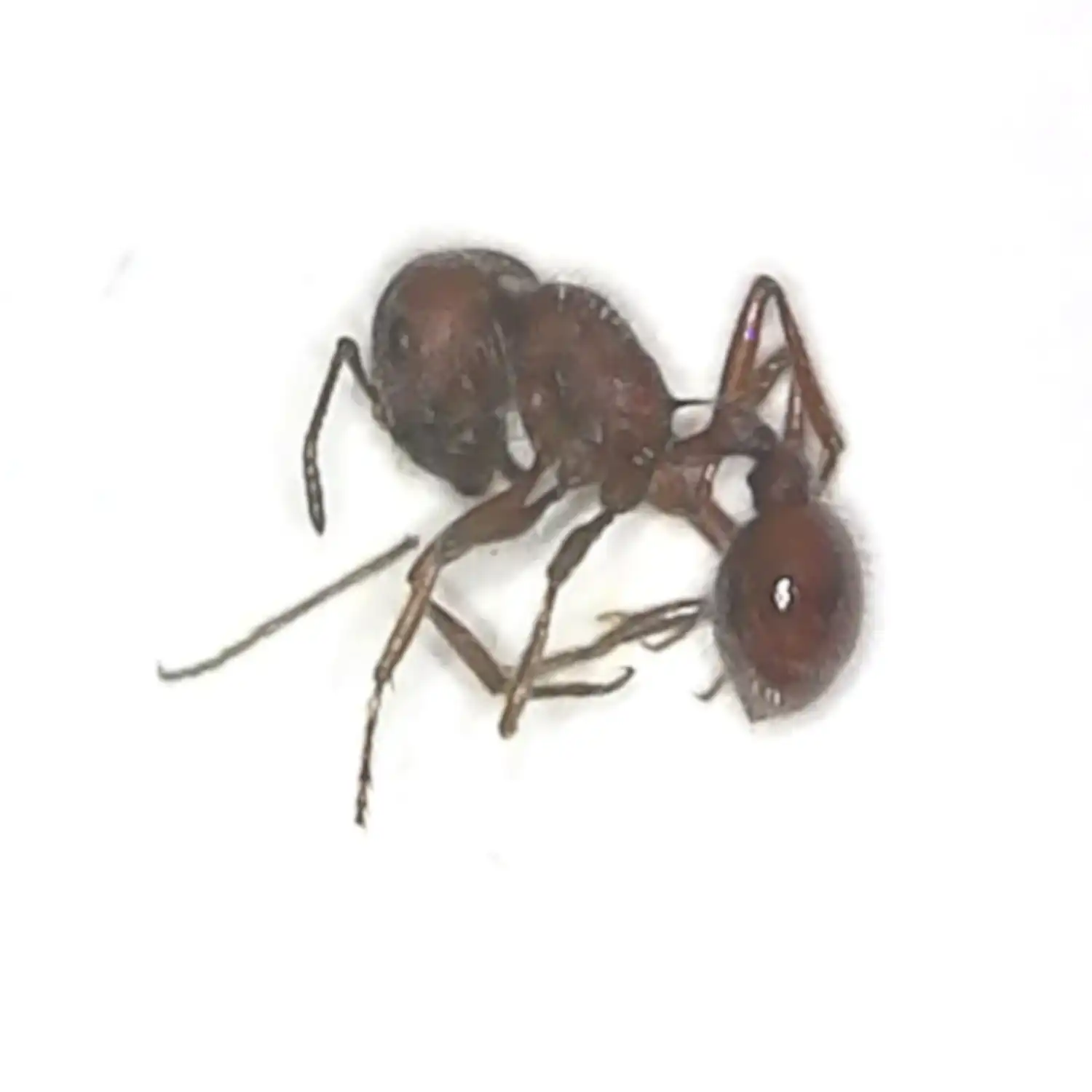
Western Harvester Ant workers are medium-sized ants, about 5 to 7 mm long and averaging about 6 mm. They are rusty red to dark red, usually the same color all over. The head and thorax are covered in coarse ridges, and the back of the thorax has a pair of pointed spines. Like other harvester ants, they have a two-segmented waist (a petiole and a postpetiole) and a “beard” of long hairs under the head, called a psammophore, that helps them carry sand and seeds. Workers vary somewhat in size, but they are not divided into distinct size classes.
The Western Harvester Ant lives in open, dry country: shortgrass prairie, sagebrush flats, desert grassland and other sunny, sparsely vegetated ground, usually with sandy or loamy soil. Its range covers the western Great Plains and much of the interior West, including southwestern North Dakota, western South Dakota and Nebraska, Kansas, Oklahoma, the Texas Panhandle, Wyoming, Colorado, New Mexico, Utah, Arizona, Nevada and parts of Idaho and eastern California. These specimens were collected near Hot Springs in Fall River County, South Dakota, and in Randall County in the Texas Panhandle.
Western Harvester Ants are famous for their nests. Workers build tall, cone-shaped mounds covered with small pebbles and gravel, often up to about 1 m across and as much as half a meter high, with a wide circle of bare ground around the mound that the workers keep clear of plants. Workers forage during the warm part of the day, mainly gathering seeds, which they store in underground chambers, and they also collect dead insects. They defend the nest aggressively, and their sting is intensely painful, with pain that can last for hours.
Like all ants, Western Harvester Ants go through complete metamorphosis (egg, larva, pupa, adult). Workers are sterile females. A worker lives about six months, starting with jobs inside the nest and becoming a forager near the end of its life. Winged queens and males fly from the nests on mating flights in summer. A mated queen sheds her wings and starts a new colony on her own, and her first workers are smaller than normal. A successful colony can grow to thousands of workers and survive for decades.
Western Harvester Ants can be a problem where people, pets or livestock meet them, because of their painful stings, and the bare circles around their mounds remove a small amount of forage from rangeland. They are also important to dry grassland ecosystems. Their digging mixes and enriches the soil, they move and store large numbers of seeds, and they are a key food of horned lizards. Paleontologists and archaeologists even search their gravel mounds for tiny fossils, teeth and beads that the workers carry up from below.
This preserved specimen educates on the mound-building harvester ants of the western plains and their role in dry grassland ecosystems, suitable for displays or studies. Check it out on BugGuide! https://bugguide.net/node/view/290352
| Weight | 0.01 lbs |
|---|
Only logged in customers who have purchased this product may leave a review.
Reviews
There are no reviews yet.