
$3.00
 <---
2 in stock
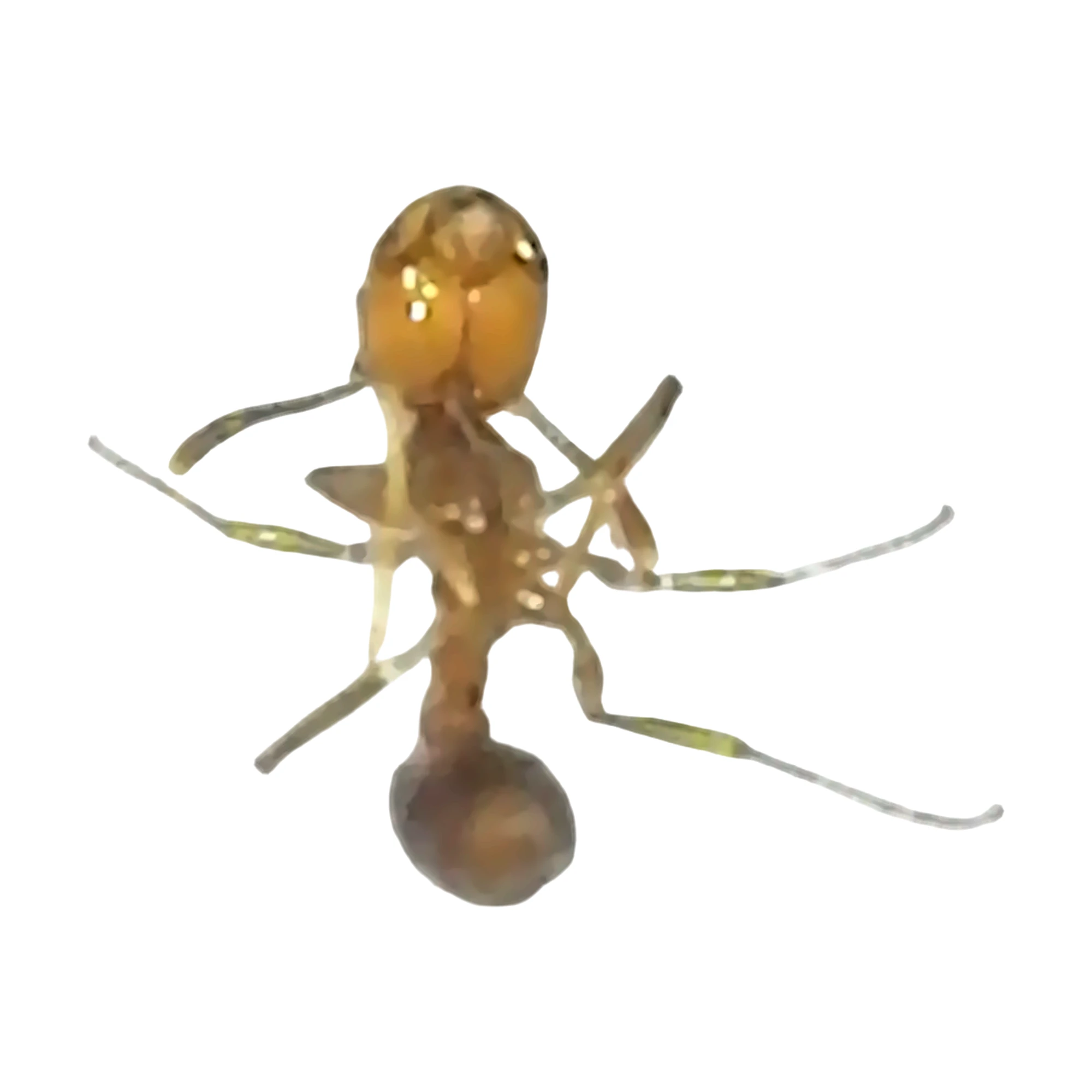
The Red Imported Fire Ant, Solenopsis invicta, belongs to the subfamily Myrmicinae of the family Formicidae. It has a reddish brown head and thorax and a dark brown to black gaster (the rear part of the abdomen). Workers in a single colony come in many sizes, from about 2.4 to 6 mm long. The waist has two segments, or nodes, between the thorax and the gaster, the antennae have 10 segments ending in a two-segmented club, and there is a sting at the tip of the gaster. The thorax has no spines.
This ant is native to central South America and was accidentally brought into the United States from Brazil between 1933 and 1945, through Mobile, Alabama, or Pensacola, Florida. It has since spread across much of the southern United States, mainly from Texas and Oklahoma east to Florida and North Carolina, with scattered populations west to California, and it has also become established in Puerto Rico, Australia and parts of Asia and the Caribbean. Arkansas is among the states with established infestations, and these specimens were collected in Pulaski County, Arkansas. It is most common in open, disturbed, sunny places such as lawns, pastures, roadsides, parks and athletic fields, where colonies build dome-shaped mounds of loose soil.
Red Imported Fire Ants are well known for defending their mounds aggressively. When a mound is disturbed, workers pour out, grip the skin with their mandibles and sting repeatedly. The venom is mostly made of alkaloids, which cause a burning pain and a white pustule that usually appears about a day later. Workers are omnivorous and eat almost any plant or animal material, alive or dead, including insects, earthworms, dead animals, honeydew and young plant growth. After heavy rain, colonies may move to higher ground or even into buildings to escape saturated soil.
Like all ants, the Red Imported Fire Ant goes through complete metamorphosis (egg, larva, pupa, adult), and development from egg to adult takes about 22 to 38 days. Once a colony is about a year old, it produces winged males and females, which fly out to mate between spring and fall, usually around midday on a warm, sunny day after rain. A mated queen breaks off her wings, digs a small sealed chamber in the soil and raises her first tiny workers on her own body reserves. The colony then grows quickly. A queen can lay as many as 1,500 eggs a day and live two to six years, and mature colonies may hold up to about 240,000 workers. Some colonies have many queens and form dense networks of mounds.
The Red Imported Fire Ant is a major agricultural, urban and medical pest in the southern United States and is listed among the world’s 100 worst invasive species. It damages crops such as soybeans, corn and citrus, its mounds interfere with mowing and harvesting equipment, and colonies nesting in electrical boxes or under sidewalks and slabs can damage equipment and pavement. Its stings are a public health concern and can cause severe allergic reactions in sensitive people. It also harms wildlife, including ground-nesting birds and other small animals. Large sums are spent on its control every year, and parasitic phorid flies from South America have been released to help suppress it.
This preserved specimen educates on one of the world’s most notorious invasive ants, its painful sting and its impact on farms and wildlife, suitable for displays or studies. Check it out on BugGuide! https://bugguide.net/node/view/30648
| Weight | 0.01 lbs |
|---|
Only logged in customers who have purchased this product may leave a review.
Reviews
There are no reviews yet.