
$3.00
 <---
96 in stock
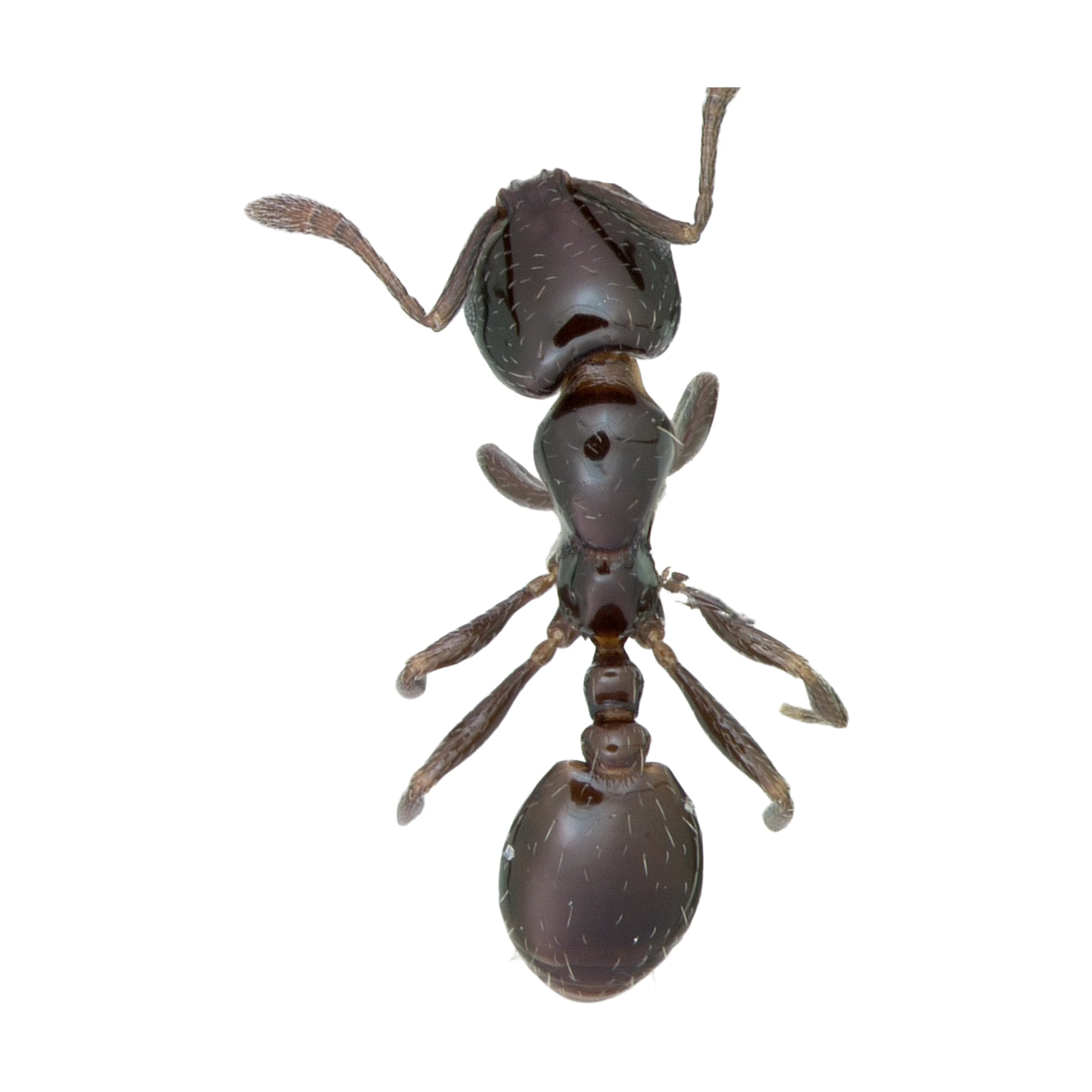
Little Black Ant workers are among the smallest ants in North America, only about 1.5 to 2 mm long. They are shiny black to very dark brown, with a smooth, glossy body and only a few scattered hairs. All workers in a colony are about the same size. The waist has two small segments (a petiole and a postpetiole), and each antenna has 12 segments ending in a distinct three-segmented club. Workers have no wings and are much smaller than the queens, which are about twice as long. In 2025 the North American ants long known as Monomorium minimum were placed under the older name Monomorium carbonarium, so newer references may use that name.
The Little Black Ant is native to North America and is found across much of the United States, from the East Coast to the Southwest, and south into Mexico. It lives in grasslands, lawns, open woods and drier wooded habitats. Colonies nest in soil, often marked by tiny craters of fine soil, and under rocks, logs, bricks and leaf litter. Indoors they may nest in wall voids, woodwork and cracks in masonry. These specimens were collected under a rock in Pulaski County, Arkansas.
Workers forage in long, narrow trails and quickly recruit nestmates to a food source. They eat a wide range of foods, including honeydew from aphids and other sap-feeding insects, nectar, live and dead insects, and, indoors, sweets, grease, meats and other kitchen foods. Workers do have a stinger, but it is so small that a sting is rarely noticed. Colonies often have several queens and can grow to a few thousand workers.
Like all ants, Little Black Ants go through complete metamorphosis (egg, larva, pupa, adult). Workers are sterile females that care for the queens, eggs, larvae and pupae, dig and defend the nest, and gather food. Winged queens and males leave the nest on mating flights, usually in summer. A newly mated queen sheds her wings and starts a new colony, raising her first workers herself.
Indoors, the Little Black Ant is a common nuisance pest because its foraging trails can reach food in kitchens and pantries. It does not damage wood or other structures. Outdoors it is a native part of the ecosystem, feeding on other small insects, and it has been recorded attacking newly mated red imported fire ant queens as they try to start new colonies.
This preserved specimen educates on one of the smallest and most familiar native ants in North America, suitable for displays or studies. Check it out on BugGuide! https://bugguide.net/node/view/256490
| Weight | 0.01 lbs |
|---|
Only logged in customers who have purchased this product may leave a review.
Reviews
There are no reviews yet.